The Eternal Whirl

Mukesh Kumar
| 14-05-2026
 · Art Team
Forget the slow, drifting pace of modern ballads; the Viennese Waltz is a high-octane mechanical feat that turns a ballroom into a rotating particle accelerator.
Born in the heart of Austria, this dance was originally considered a "social glitch" because of its sheer speed and the scandalous proximity of the partners.
It operates at a blistering 180 beats per minute, requiring a dancer to manage centrifugal forces that would cause a structural collapse in a lesser technique. To master the Viennese Waltz is to become a high-precision specimen of kinetic energy, navigating a circular "SOP" that has remained unchanged for centuries. It is not just a dance; it is a study in fluid momentum and structural balance.
The Mechanics of the 3/4 Pivot
The foundation of the waltz is the "3/4 time signature," but the Viennese variant adds a layer of mechanical complexity through its rotational velocity. Unlike the standard waltz, which features "rise and fall," the Viennese version prioritizes "linear progression through rotation."
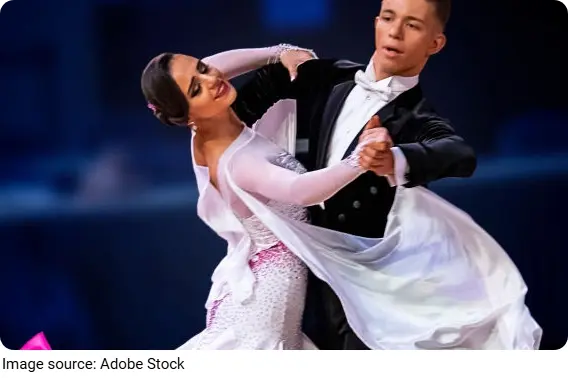
The dancers must execute a full 360-degree turn over the course of just six steps (two bars of music). This requires a "pendulum swing" of the body, where the legs act as levers to propel the frame forward. The lead must maintain a stable "axis of rotation," while the follower acts as a counterweight. If the atmospheric tension between the two partners breaks, the centrifugal force will fracture the movement, causing the couple to drift off their path. It is a biological machine where every joint must act as a shock absorber to maintain a level "top line" while the feet are moving with industrial speed.
The Ballroom Specimen Checklist
To perform at a competitive or traditional level, the "SOP" for attire and technique must be strictly calibrated. Every component of the dancer's gear serves a mechanical purpose in managing the spin.
The Viennese Performance Specs
• Suede-Soled Footwear: The "friction coefficient" must be perfect. Suede soles allow for a "controlled slip," enabling the dancer to pivot on the ball of the foot without catching on the floor grain.
• The "Frame" Tension: Partners must maintain a "positive resistance" in their arms. This isn't a hug; it is a structural brace that allows the lead to communicate direction through tactile feedback.
• The Flexed Knee: To manage the sudden acceleration, the "standing leg" must remain slightly flexed. This lowers the center of gravity and prevents the "toppling moment" during high-speed turns.
• The Reverse Turn: A technical "circuit breaker" that prevents dizziness. By alternating between Natural (right) turns and Reverse (left) turns, the dancer recalibrates their inner ear and maintains a straight path down the line of dance.
A Night in Vienna
To see this specimen in its intended environment, you must participate in the "Ball Season" in Vienna. These are formal events where the architecture of the hall acts as a secondary resonator for the live orchestra.
• Primary Venue: The Hofburg Palace or the Vienna State Opera House.
• Transportation: Vienna has a high-precision public transit system. A 24-hour pass costs approximately $9. Use the U-Bahn (Subway) lines U1 or U4 to reach the city center (Stephansplatz).
• Admission Pricing: Tickets for a prestigious ball can range from $150 for a standard "standing" entrance to over $800 for a reserved table in a private box.
• Dress Code: This is a non-negotiable SOP. Gentlemen must wear a black tailcoat or tuxedo; ladies must wear a floor-length evening gown. Failure to comply results in denied entry at the gate.
The Stillness Within the Spin
The most fascinating aspect of the Viennese Waltz is the paradox of its center. While the feet are moving at a frantic pace and the skirts are flying outward like a Tanoura dancer's, the upper bodies remain uncannily calm. It is a "dynamic stillness." The dancers are the quiet center of their own storm.
Reflect on your own "pace": Are you moving so fast that your structure is collapsing, or have you learned to maintain a stable "frame" amidst the chaos? The Viennese Waltz teaches us that speed is only beautiful when it is controlled. It reminds us that we can navigate the most high-pressure environments with grace if we find our axis and trust our partner. True mastery isn't about the speed of the turn; it's about the precision of the pivot. Are you ready to step into the 180-beat-per-minute rhythm of your own life, or are you afraid that the spin will take you off your feet? Success is found in the momentum.
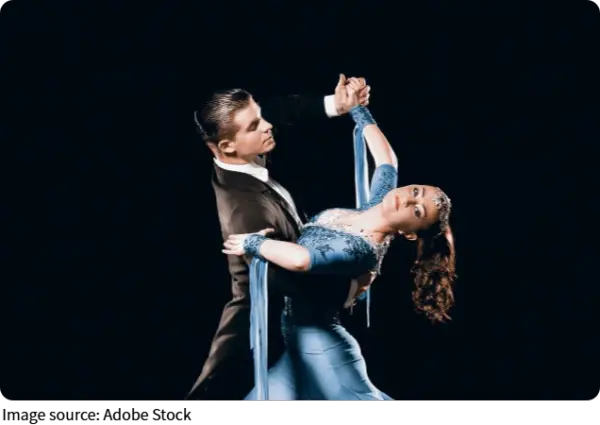
The Viennese Waltz is more than a traditional ballroom dance — it is a powerful blend of speed, balance, precision, and elegance. Through constant motion and controlled rotation, dancers learn to maintain stability even in the middle of chaos. Its timeless rhythm, technical discipline, and emotional connection continue to make it one of the most captivating dances in the world. Whether viewed as an art form or a metaphor for life, the Viennese Waltz reminds us that true grace comes from staying balanced while moving forward.